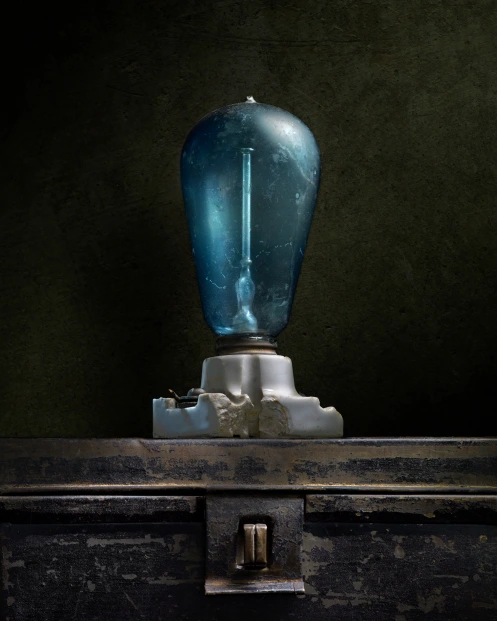
Hi everyone! Things have been hopping at the studio, and I haven’t had much time to do a post. We just finished a group workshop this past weekend, which went very well. It was a great group, and Roman and I had a lot of fun while teaching the intricacies and benefits of light painting the still life. The group was made up of people from Boston and Atlanta, as well as some relatively local photographers. I’ll be posting a grouping of the images created by the students, but in the meantime, I thought I would share the image I created as a demonstration to the group at the beginning of the workshop. My friend and fellow photographer, John Corcoran, recently gave me these great old boxes.
Vintage Coffee Grinder
•January 14, 2012 • 9 CommentsThose of you that know me know how much I enjoy coffee. Okay…scratch that. I LOVE coffee. How the grind, the pump pressure and the tamp pressure affect the extraction time is a science all its own. There really is a difference in how extraction time affects taste, and those of you that choose to take my workshop will get to taste it first hand and judge for yourselves! I thoroughly enjoy making great coffee for friends, family, and neighbors.
Speaking of neighbors… another man with a passion for coffee is my neighbor here at the studio, Don Ervine. His company, Tally Ho Coffee, specializes in roasting coffee right here in West Chester, PA.
I ran into Don the other day, and he showed me an old coffee grinder he had picked up at an antique shop. As soon as I saw it, I knew that I had to photograph it. He gladly handed it over and I brought it into the studio and made a photograph of it. Here it is!
Video of animation of light painting in the landscape.
•January 5, 2012 • 9 CommentsSo, lately I’ve been thinking about a cool little project… I thought it might be fun to create a video animation from the still shots of one of my landscape photographs. Shooting video of me light painting is problematic. Since I’m in complete darkness, it’s very difficult to get a good exposure in the video. It basically looks like an incredibly bright light surrounded by blackness. I’m the first to admit that I’m not a videographer, and I thought that since my still exposures were adjusted through the use of time and motion and distance, that the animation would be much more interesting. I created it in Photoshop, and basically, it’s a compilation of all of the separate captures that I shot and later very simply masked together for the final image.
Please make sure that after you hit the play button, you click on the HD button on the upper right for a sharper image!
Some of you have asked for a slower version… here it is, below the original.
Check it out:
A Poll…I’m trying out an alternate method of framing… please tell me what you think!
•December 30, 2011 • 6 CommentsI’m trying out an alternate method of framing for my images. Juror Debra Klomp Ching, of Klompching Gallery, NY, chose “Untitled #22″ as one of just 24 images from over 1,000 submitted for the “New Directions 2012- Crossing Territories” group exhibition to be held at Wall Space Gallery. Wall Space will hang the exhibition in their gallery in Santa Barbara, California, and then in Seattle, Washington, in their shared exhibition space with City Catering Company.
The print was face mounted to semi-matte acrylic, then mounted in a “floater” frame. The piece sits about 1/8″ below the surface of the frame. I think it’s a nice look, and the image can be made at my normal 24″ size without requiring a large frame. What led me to think about this was the need to ship my work to other parts of the country for exhibits, and the inherent difficulties in shipping a piece in a larger frame with glass.
Please let me know – via the poll at the bottom of the article – how you like it!
New Directions 2012 – January 4th – 29th, 2012 – Santa Barbara, CA. Opening reception January 5th, 2012
New Directions 2012 – February 2nd – March 4th, 2012 – Seattle, WA – @ City Catering Company.
Xiang Sha Wan – Inner Mongolia, China – Almost one year ago…
•December 23, 2011 • Leave a CommentYan Li, Founder and Director of High Noon Culture and Art Corp, Beijing, China, recently contacted me. She let us know that as part of the celebration of the Xiang Sha Wan Photography Exhibit, which I participated in last winter, photographs from some of the 10 participating American photographers would be featured in several books commemorating the event. I just received three of these beautiful books from her. They are really lovely, and beautifully made…. now if I could only read Mandarin! I’ll have to get my son Jonathan to help me translate. Yan sent my books home with Jim Abbott, a fellow photographer from Philadelphia. Thanks Jim, for carrying them all the way from China!
Seeing all of these pictures brought back so many memories of the trip last of December / January. What a wonderful time we had, and Vera and I will forever have fond memories, and we made some life-long friends! It’s hard to believe that it’s been almost a year. In some ways it seems like a life-time ago, and in other ways, especially with this cold weather, it seems like last week! That said, the thermometer would have to dip another 50 degrees lower to match the -20F that we had in Inner Mongolia!
The American and Chinese Photographers at the conference.
Photo by unknown photographer
Photos by unknown photographer
In case you missed my blog posts from the trip and exhibition, or would like to revisit them, here are the posts from last year:
Read December 14th and 31st blog posts:
http://haroldrossfineart.wordpress.com/2010/12/
Read the January blog posts:
http://haroldrossfineart.wordpress.com/2011/01/
And, Brooks Jensen had some informative and very funny stuff on his blog:
http://xiangshawan.lenswork.com/page/3/
Joe Lipka’s blog posts on the trip, also funny!:
Light Painting Tips and Technique: The Shape of Things…
•December 5, 2011 • 7 CommentsI’ve been thinking a lot about writing posts dedicated to specific aspects of making photographs with light painting. Finding the time, however, isn’t so easy!
These posts will probably appeal mostly to photographers, but I’m hoping that even you non-photographers will find them interesting. Of course, they’ll be pertaining to the intricacies of lighting (for the most part).
In general, photographic lighting is intimidating. In my workshops, I break lighting down into a few simple rules or principles. These principles are easy to grasp, and there are only a handful of them, but learning to use them together in a fluid way is the biggest challenge of light painting.
The information that I’ll be presenting in these blog posts is information that I teach in my workshops.
Remember, these images are made in a dark studio, while applying the light over a time exposure, and while moving the light for desired effect. The same principles apply to landscape work, but on a larger scale.
So, today’s post is an abbreviated look at how the angle of light can and does enhance shape and texture.
For all of these demonstrations, I’ll be using a simple LED flashlight with homemade diffusers, using the same tools and techniques that I teach in my workshops.
I can’t emphasize enough how important lighting angle is. It’s important and powerful. As an exercise and demonstration, I’ve taken a flat metal plate which has a patina and photographed it several ways.
The 1st image is as one would expect… The flat metal plate looks… well, flat. The lighting is coming from roughly a 45° angle up and to the right, and the lighting has been applied evenly across the surface of the plate.
Now here comes the fun part… With lighting alone, I can make this flat metal plate look very much like a sphere. I’ve used my LED flashlight, and moved it so that the light is smoothly blended from highlight to shadow, and concentrating it where one might expect to see a gradation of light on a sphere. This is simply applying light as a painter would apply white paint to create depth and shape. I find it amazing that we can easily make a flat surface look round, but imagine how much easier it is to enhance the shape of something that already has some shape!
Next, I wanted to demonstrate something that is fairly obvious, a subject that gets a lot of attention in the workshops… that is, how lighting from anywhere near the camera angle is not a good thing. We all know that on camera flash produces a flat light, and we live with it out of necessity sometimes, but in the studio and especially in light painting, we have total choice and control over where we place our light. In the workshops, I find myself repeating the mantra “Don’t light from the camera”, so here I wanted to visually demonstrate how light on the camera angle destroys shape and texture. Pretty bad, huh?

The next image shows what happens when we light for shape, and employ the same basic technique I used above with the metal plate. I am lighting the baseball, applying the light in a specific area that enhances the shape of the ball. This image is a lot better than the previous one, right?
Now, how do we create shape while at the same time, enhancing texture? Texture is revealed and enhanced by “raking” or “skimming” the light. Here are 2 images, close-ups of the flat metal plate. One is lit with a “normal” lighting angle, and the other is lit with an extremely shallow angle, where I am raking the light, or skimming it across the surface of the plate. Notice the tremendous amount of texture which is revealed by the shallow lighting angle. The lighting angle is the only difference between these two images.

With the baseball, we want to create overall shape, but to maintain the texture of the surface of the leather, we must skim the light across the surface of the baseball as opposed to aiming the light directly at the baseball. The way I explain it in the workshops is to imagine the “cone of light” coming from the light source, and then concentrate on using only 1/3 or so of that cone of light. This forces us to skim the light across the surface of the object.
See my attempt at an illustration:
Below are 2 images, close-ups of the baseball surface. One shows the texture we get when aiming the light directly at the baseball, and the other shows the texture we get when we skim the light. It’s a bit subtle, but for me, it’s about the details.
So, I hope you enjoyed these little exercises… I am constantly amazed at the power of light, and how light painting can make something that is relatively mundane look absolutely fantastic!
Until next time,
Harold
One-on-One Light Painting Workshop – Ruth Feldman
•November 21, 2011 • Leave a CommentRecently, I had the pleasure of teaching a One-on-One Light Painting Workshop to Ruth Feldman. Ruth traveled by train from the Boston, Massachusetts area.
Ruth is a fine artist, in both photography and painting, and she was a real pleasure to work with. Her passion for photography was apparent, and her positivity and enthusiasm were contagious! It was a very fun weekend.
After going over lighting theory with Ruth, demonstrating the light painting process, along with my tutorial of Photoshop methods as they apply to light painting, you can see that she really caught on! Ruth produced the two lovely images below. Other students’ work can be seen in our Workshop Image Showcase.
“The One-on-One workshop was one of the best creative experiences I have ever had. Light painting done the way you teach it gives the most extraordinary results. I learned so much and had a lot of fun doing it. I can’t thank you enough.” – Ruth Feldman
Beautiful still life by Sonia Nunez.
•November 9, 2011 • 2 CommentsNew Website Launched!…Well, it’s been a few weeks, but…
•November 2, 2011 • 5 CommentsI am proud to announce my newly updated website: www.HaroldRossFineArt.com
It’s been up for a few weeks and there were some glitches to fix (Thanks to Sonia Nunez for the head’s up on one of those glitches!) so some of you may have seen it by now. However, if you haven’t…. please take a moment to check it out.
No more small images!! We have just completed the website crossover to a new scaler site, which makes the images full screen to the viewer’s monitor, no matter your screen size. Ideally, whether you are viewing on a 13″ laptop or 30″ monitor, you will be seeing the largest image possible on your screen.
So if you get some time to view my new site, please take a minute to let me know what you think! We are always curious to see if the quality comes across on the different monitors and platforms out there. Thanks!
-Harold
One-on-One Light Painting Workshop – Marc Forand
•October 28, 2011 • 2 CommentsI just completed teaching a One-on-One workshop with Marc Forand, who is from Toronto, Canada. Take a moment to check out his website. I especially like the opening page, a light painted landscape with rollover titles that he created at the scene!
Marc is a videographer who has a strong interest in still photography, and we had a great weekend learning the intricacies of light painting.
He travels a lot, and works on TV and Motion pictures all over the world. Marc told me stories of his trips to Cambodia, Vietnam, Thailand, the Middle East and many other faraway places.
With his interest in all things photographic, Marc decided to scout the studio for some old photo equipment to include in his still life image. On one of my shelves, we actually found a roll of film from 1958!
Here’s what Marc had to say:
“The overall experience of the workshop was excellent. Harold’s methods of teaching and the structure of the workshop made for a great learning experience. The workshop has made me see lighting from a fresh perspective, and I have no doubt the technique used in this workshop will apply well to cinematography as well. The Photoshop knowledge that I gained from this workshop is priceless, and I recommend the workshop to anyone who wants to take their photos to the next level!” – Marc Forand, Toronto – One-on-One Light Painting the Still Life (October 2011)


